‘The Odyssey’ Review
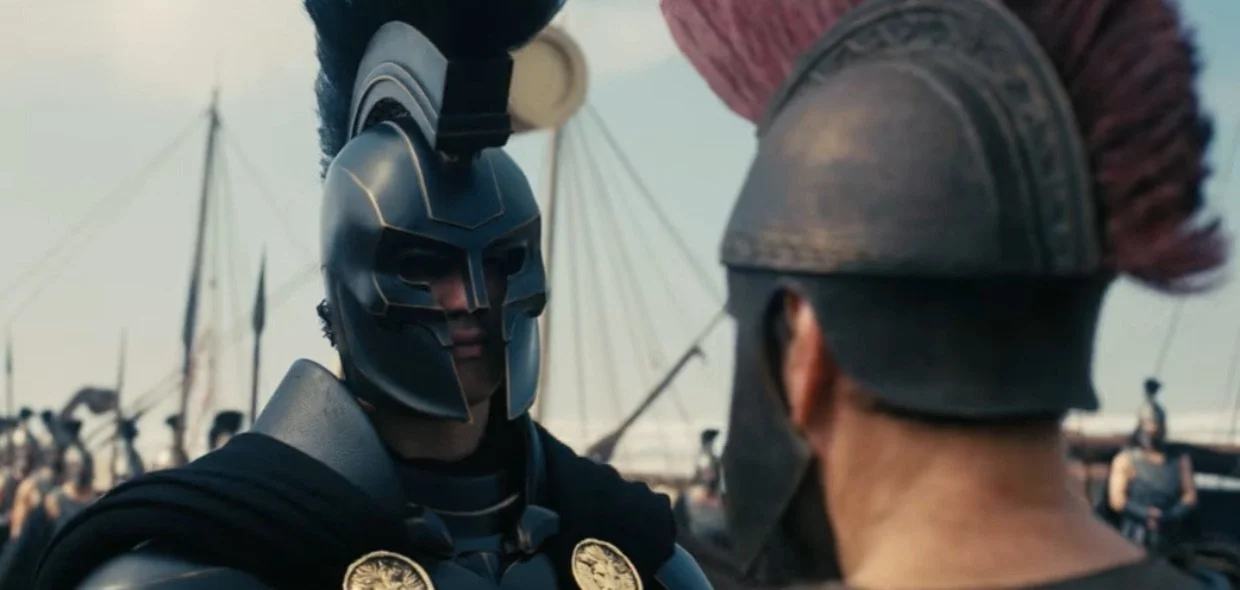
‘The Odyssey’ Review: The Facade of Commitment
Christopher Nolan has always been a filmmaker defined by ambition, but somewhere between Tenet, Oppenheimer, and now The Odyssey, that ambition has begun to evolve into something else entirely. His films are no longer simply experiences to watch. They have become demonstrations of commitment. Every conversation surrounding a new Nolan release inevitably returns to the same talking points. It was shot on location. The effects were practical. The stunts were real. The cameras were pushed further than ever before. All of it is undeniably remarkable, and few directors possess the resources or determination to pull it off. The question The Odyssey left me asking, however, is whether we have slowly begun confusing extraordinary filmmaking with extraordinary displays of filmmaking.
There is no denying the craftsmanship on display here. Nolan assembles another staggering ensemble and places them inside breathtaking landscapes that feel impossibly tangible. Every frame carries a sense of scale that reminds you why practical filmmaking still matters. It is difficult not to admire the sheer amount of labor behind every sequence, and The Odyssey often feels like one of the most technically demanding productions ever mounted.
Yet admiration and emotional investment are not always the same thing.
Watching The Odyssey often feels like watching a three hour montage of astonishing achievements. One breathtaking sequence gives way to another before the previous one has a chance to settle. Nolan's camera is constantly moving toward the next revelation, the next spectacle, the next impossible feat. There is very little room for silence or reflection, and even less space for the audience to simply exist alongside these characters.
That has become the defining contradiction of Nolan's recent work. His commitment to realism has arguably never been stronger, but his films increasingly feel emotionally detached. It is a strange sensation to witness some of the most impressive images modern blockbuster filmmaking has produced while simultaneously feeling held at arm's length from the people inhabiting them.
The performances deserve better than that distance. Anne Hathaway delivers some of the film's most emotionally grounded moments, while Zendaya and Samantha Morton bring welcome humanity to a story that often threatens to become overwhelmed by its own momentum. Their work hints at a richer, quieter film beneath the surface, one that occasionally breaks through before being swept away by another meticulously orchestrated set piece.
That raises a larger question about where Nolan is headed as an artist. Is this acceleration intentional? Has he recognized that audiences consume media differently than they did twenty years ago? We live in an era of fractured attention spans, algorithmic feeds, and constant stimulation. Perhaps The Odyssey reflects that reality, embracing perpetual motion because it understands that modern audiences rarely sit still. Or perhaps this is simply where Nolan's own interests now lie, less concerned with emotional stillness than with engineering cinematic momentum.
The uncertainty is what makes the film so fascinating to wrestle with. I do not believe Nolan has become a lesser filmmaker. If anything, his technical command has reached heights few directors in history could imagine. What has changed is where that energy is being directed. His earlier work, particularly films like Memento, trusted restraint as much as invention. They understood the power of allowing an idea, a performance, or even a single image to linger. The Odyssey rarely grants itself that luxury. Every scene feels obligated to prove something before it can simply breathe.
Perhaps that is the inevitable evolution of a filmmaker whose every release is treated as a cinematic event. Nolan has become one of the few directors whose productions generate as much excitement as the films themselves. The process has become inseparable from the product, and discussions of his work often begin with how it was made before arriving at what it is trying to say.
The Odyssey is undeniably spectacular. It contains moments that reaffirm why Christopher Nolan remains one of the most ambitious filmmakers working today, and its technical accomplishments deserve every bit of recognition they receive. But the film also left me wondering whether commitment has quietly become the destination instead of the vehicle. For all of its astonishing craft, I kept waiting for the spectacle to give way to something more intimate, something willing to pause long enough for emotion to catch up. It never quite does, and that absence is ultimately what lingers long after the images fade.