‘The Invite’ Review
‘The Invite’ Review: The Art of Redemption
Few filmmakers have had a career trajectory quite like Olivia Wilde's. Booksmart immediately established her as one of the most exciting new directors working today, blending sharp comedy with genuine emotional honesty. Then came Don't Worry Darling, a film that was almost impossible to separate from the conversation surrounding it. For years, Wilde's work has been discussed through the lens of headlines instead of filmmaking. The Invite feels like the moment that narrative finally changes. Returning to Sundance with a deeply personal film that was ultimately picked up by A24, Wilde has come back doing things entirely on her own terms, and the result is easily her most confident work to date.
There is something refreshing about how comfortable The Invite is with simply letting people talk. In an era where so many films feel obligated to constantly move or escalate, Wilde slows everything down and places her trust in conversation, performance, and the small emotional shifts that happen between people who know each other perhaps a little too well. It is a style of filmmaking that feels increasingly rare, recalling the intimate relationship dramas and comedies that filmmakers like Woody Allen once made so effortlessly. Wilde borrows some of that DNA but reshapes it into something distinctly contemporary, trading nostalgia for an honest look at marriage, aging, and the quiet anxieties that come with long term relationships.
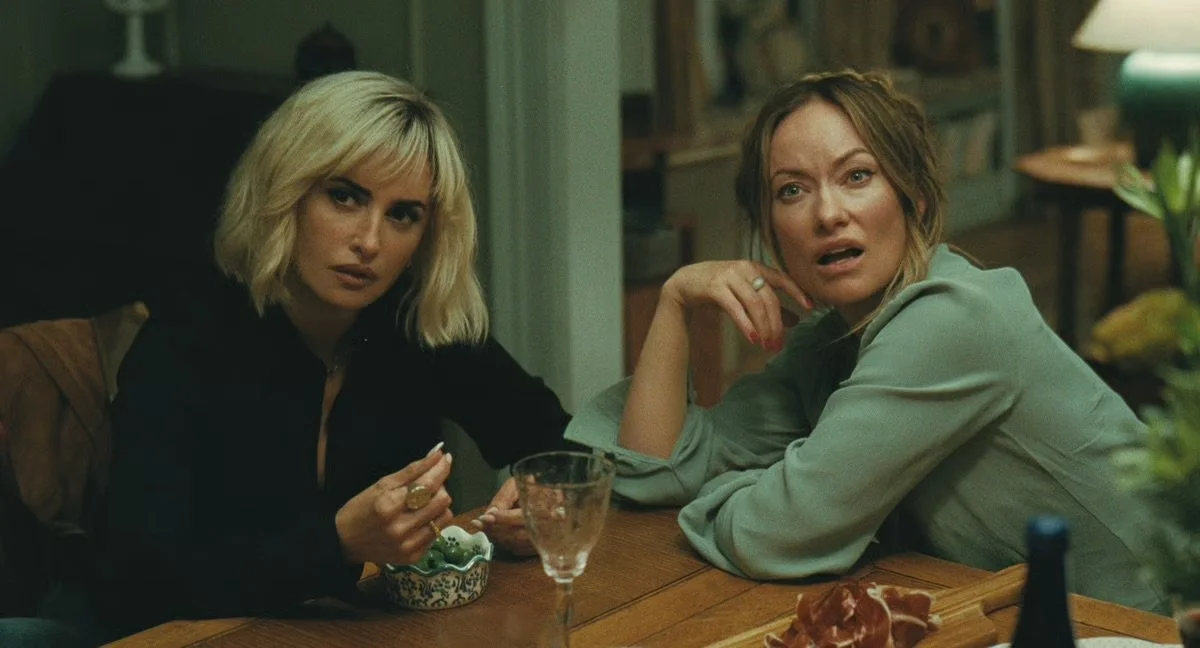
The ensemble is where the film truly comes alive. Seth Rogen, Edward Norton, Penélope Cruz, and Olivia Colman make for an extraordinary quartet, each finding the perfect rhythm between comedy and vulnerability. Their chemistry feels effortless, and Wilde wisely allows them the room to bounce off one another without forcing dramatic moments that do not need forcing. Conversations drift from hilarious to painfully uncomfortable in the span of a few lines, and the film trusts the audience to sit with those transitions rather than overexplaining them.
What makes The Invite so rewarding is its refusal to offer simple answers. Marriage is messy, funny, frustrating, deeply loving, and occasionally isolating, sometimes all at once. Wilde never paints her characters as heroes or villains. Instead, she is interested in the compromises people make, the insecurities they carry, and the strange ways intimacy evolves over time. Even at its funniest, there is an undercurrent of melancholy running through the film that gives every laugh a little more weight.
Visually, the decision to shoot on film feels essential rather than nostalgic. Every frame carries a warmth and softness that perfectly complements the story's emotional intimacy. The cinematography never calls attention to itself, but it quietly reinforces everything the characters are feeling. There is a tactile quality to the image that makes the film feel grounded and lived in, something that pairs beautifully with Wilde's understated direction.
Devonté Hynes' score is another standout. His work as Blood Orange has always carried an emotional richness, and that same sensibility flows through The Invite. The music never overwhelms a scene. Instead, it gently fills the spaces between conversations, adding another layer of tenderness and uncertainty without ever becoming intrusive.
More than anything, The Invite feels like a film made by someone who has complete confidence in her voice. After years of having outside noise define the conversation around her work, Olivia Wilde has responded in the best possible way by making something deeply personal, remarkably funny, and emotionally mature. There is no sense that she is trying to prove anyone wrong. She is simply making the kind of film she believes in.
That confidence is what makes The Invite so satisfying. In a landscape increasingly dominated by spectacle and digital excess, Wilde has delivered a wonderfully human film that finds extraordinary drama in ordinary relationships. It is funny, quietly heartbreaking, beautifully acted, and refreshingly unafraid to sit with life's uncomfortable conversations. More than a comeback, The Invite feels like the arrival of a filmmaker who has fully settled into her own voice, and that is exciting to watch.