I Want Your Sex Review
Gregg Araki Wants to Talk
After more than a decade away from feature filmmaking, Gregg Araki finally came home to Sundance this January with I Want Your Sex. Twelve years removed from White Bird in a Blizzard, the director’s return carried the anticipation that naturally follows a filmmaker whose absence has only made his influence easier to see. From the nihilistic teenagers of the Teen Apocalypse Trilogy to the candy-colored apocalypse of Kaboom, Araki has spent his career turning alienation, sexuality, and youthful confusion into something abrasive, funny, and distinctly his own. Following its Sundance premiere and a festival run throughout the spring, I Want Your Sex finally arrived in theaters on July 31. Yet for a filmmaker who has so often announced himself through confrontation, his return is surprisingly interested in finding common ground.
This is, in many ways, Araki at his most mellow. Not aesthetically, necessarily, I Want Your Sex still indulges in the hyper-stylized compositions, absurdist humor, sexual frankness, and pop-cultural overload that make his films immediately recognizable, but philosophically. Rather than simply provoking a younger generation, Araki seems genuinely interested in understanding one.
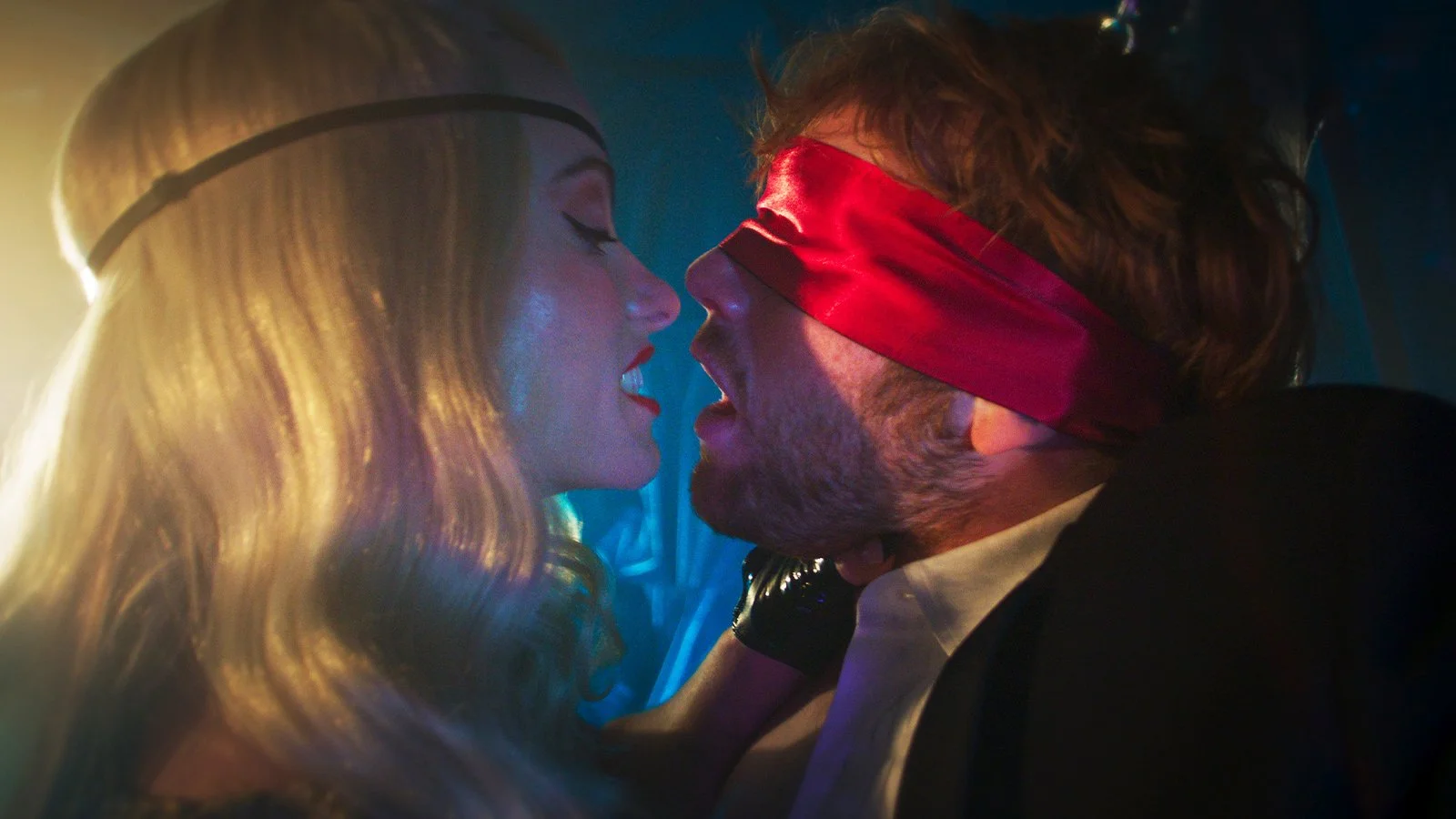
His conduit is Elliot (Cooper Hoffman), a 23-year-old drifting through contemporary Los Angeles who lands a job assisting renowned artist Erika Tracy (Olivia Wilde). Erika is everything Elliot isn't: commanding, uninhibited, self-assured, and almost militantly comfortable with desire. When she selects her new assistant to become her sexual submissive and muse, their relationship becomes a collision between two different attitudes toward sex. What initially looks like an excuse for Araki to gleefully scandalize a younger generation gradually reveals itself as an attempt to build a bridge toward it.
Elliot belongs to a generation that Araki views as paradoxically surrounded by sex while increasingly cautious of it. The film repeatedly circles questions of consent, boundaries, pornography, shame, labels, and the strange distance that can exist between digital sexual expression and physical intimacy. Erika, meanwhile, approaches sex almost as an antidote to overthinking. For her, desire is supposed to be messy, embarrassing, impulsive, and occasionally transformative.
It is within that generational collision that I Want Your Sex becomes a whirlwind of classic Araki. The film gleefully bounces between erotic comedy, murder mystery, art-world satire, and relationship farce, refusing to stay within any respectable boundary for particularly long. Araki may be extending an olive branch, but he hasn't lost his appetite for vulgarity.
And then there is Olivia Wilde.
Wilde attacks Erika with such charisma that the film seems to rearrange itself whenever she enters a room. Draped in the exaggerated confidence of an old-school femme fatale filtered through Araki's neon sensibilities, she understands that Erika works best somewhere between a person and a performance. Every command, insult, and seduction feels slightly theatrical, as though Erika understands that everyone around her is already watching. Wilde embraces that artificiality rather than attempting to humanize it away, giving the film the larger-than-life presence it needs.
Hoffman proves an ideal counterweight. His Elliot is wonderfully uncomfortable in his own body, his boyish uncertainty bouncing against Wilde's almost frightening command of hers. More importantly, their chemistry prevents the film's generational divide from becoming entirely theoretical. There is genuine curiosity between them. Even when their dynamic becomes ridiculous, Wilde and Hoffman make it believable that these two people might find something in one another that their respective worlds cannot provide.
The difficulty comes when Araki stops allowing that relationship to make his argument for him.
For a filmmaker whose greatest provocations have often thrived on refusing easy answers, I Want Your Sex can become unusually eager to explain itself. Its observations about Gen Z's supposed retreat from sex are funny and occasionally perceptive, but they can also flatten an enormously complicated cultural shift into a debate between repression and liberation. Elliot's anxieties are shaped by a world fundamentally different from Erika's, and while Araki recognizes that divide, his sympathies remain clear. The film occasionally feels less like a conversation between generations than a particularly charismatic lecture from one to another.
It is a strange limitation precisely because Araki has always been most persuasive when he isn't trying to persuade anyone. His best films don't need to defend their transgressions; they simply exist in them. Desire in Araki's cinema has historically been dangerous, ridiculous, euphoric, traumatic, and contradictory all at once. Here, when that messiness is transformed into an argument for sexual liberation, some of its potency disappears.
Thankfully, I Want Your Sex is far too restless to become a sermon. Every time its thesis threatens to overwhelm it, Wilde and Hoffman drag the film back toward something stranger, sexier, and more human. Their chemistry gives Araki's generational bridge an emotional foundation that his broader cultural argument sometimes lacks.
Perhaps that makes I Want Your Sex an appropriately complicated return. Araki has come back older and seemingly more interested in talking to the young people who have inherited the cinematic culture he helped shape than shocking them. The conversation doesn't always land, but watching him attempt it remains enormously pleasurable. If I Want Your Sex ultimately proves that Araki is strongest when he's provoking rather than preaching, there are far worse problems for a filmmaker to have.
After twelve years away, it's simply good to have him provoking again.