We Are Living Through Hell.
Review: Alpha by Julia Ducournau
“I’m not sure if we have truly hit rock bottom, but I hope if it’s not now, then it will come soon, because I’m not sure how it can get any worse than this” (Julia Ducournau).
It appears to be about an hour and a half when the couple in front of me decides they can’t take any more of Ducournau’s latest feature, Alpha. The boyfriend picks up his popcorn and jogs to the dimly lit staircase while watching his girlfriend attempt and fail to step over other moviegoers with her eyes closed. I’m not sure if these are tears of sadness or fear, but either way, I’ve never felt more at home. They finally make it to the exit, where I witness them share a hug before finally bailing before the final act, and in my mind, I register that I’ve never been happier to be in Los Angeles.
I first saw the announcement of Durcournau’s latest feature, Alpha, screening early in LA a few days before the event itself. It was a far from average winter day in LA, about 80 degrees and sunny, while my family on the East Coast was chattering in our group chat about their snow storm preparations. I continued my dystopian scroll on Instagram, seeing another American had been killed by ICE, further documents from the Epstein files had been released, and many other patriotic news stories to start my Sunday. It was when my brain felt perfectly rotted that I attempted to snag tickets to the early screening at the Century City AMC.
Fortunately, luck was on my side that afternoon. A few days later, I was driving towards Santa Monica to pick up my friend for the ride. I decided to keep him in the dark, telling him we were seeing a horror movie. Otherwise, I’d likely have been riding solo on that Tuesday evening. Once we arrived, we trekked to the back of the theater to take our seats. A few torn-up red upholstered chairs were our thrones as we prepared to bear our eyes upon Ducournau herself. Another moviegoer plopped down beside me with a tray of chicken fingers from the AMC snack stand. I realized that if I got the chance to speak a single word to Julia tonight, I would do so while smelling of buffalo sauce.
I also guiltily acknowledge I wasn’t too sure what I was getting into. I had seen reviews on Alpha ever since its premiere at Cannes last May. I wasn’t too sure what to think. Regulars on Letterboxd called it her weakest feature yet, while others decorated it with five stars. It seemed there was no middle ground with this movie. Maybe that’s just a direct metaphor for where society is headed in general. No middle ground, no unity, no common sense. You’ll love it, or you’ll hate it. Perfect.
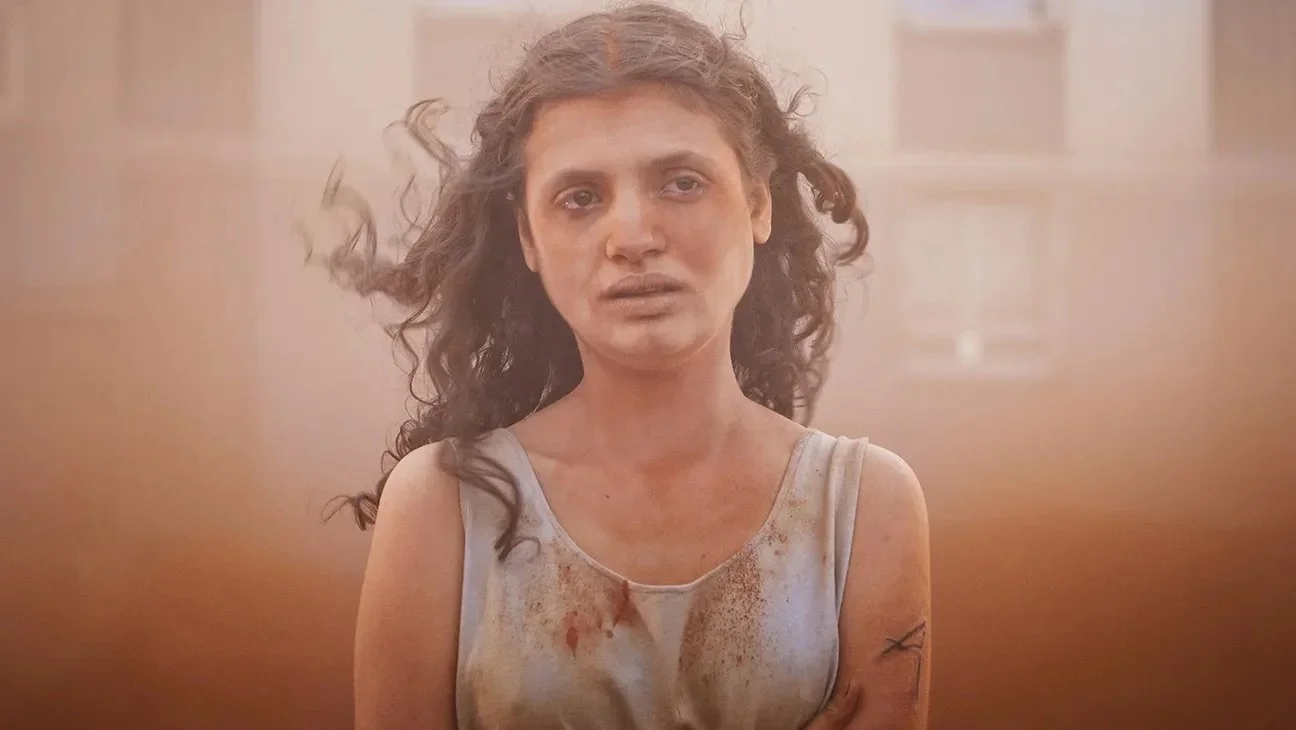
The film begins, and the journey of 13-year-old Alpha, portrayed by Mélissa Boros, unfolds on the IMAX screen. The film spreads through the triangle of Alpha, her mother, played by Golshifteh Farahani, and her junkie uncle, Amin, portrayed by Tahar Rahim. The chronicle showcases the aftermath of the teenager's split decision to get a tattoo at a trashy house party, where all the drama unfolds from that point forward.
The tattoo created by an unsanitary needle creates the domino effect in which Ducournau parallels her experience witnessing the AIDs crisis ravage her community and loved ones. Alpha is thrust into a world of propaganda, bullying, and hardships throughout her everyday life. From facing scrutiny at school to returning home and being crushed by the tension between her mother and uncle’s failing relationship, she is crushed in every daily interaction.
Alpha and Amin parallel each other’s experience at times, a diptych still crucially separated by the huge difference in the choices they have made. Alpha reflects the isolatory nature of youth, and the exposure of her “mysterious disease,” as noted by her classmates, continues to destroy any sense of social stability in her life. Amin, grounded in his addiction, journeys in and out of the house, utilizing any path he can to get to his next fix. Amongst family meals, nights out, and even flashbacks to Alpha’s childhood, we see an unbreakable cycle of heroin abuse destroying his own sanity and physicality.
As soon as the story seems feasible and the pieces start to fit together, Ducournau surprises you with an unrecognizable disease emerging among the French population. The bodies of patients in hospitals appear almost like pristine porcelain, showing how fragile the average person is and how quickly a loved one can be lost. In a brief flashback, we see that Amin was once one of those unlucky individuals. He is shown strapped to a hospital bed, covered in visual effects that give his body an almost marble-like appearance. It is only through this moment that Ducournau’s latest film reveals its meaning.
An allegory for familial trauma within the AIDs epidemic, the mystery disease is rebirthed to enact that same fear on Alpha’s family as the mother-daughter duo panic amongst a crisis of social isolation, declining health, and an unbreakable fear of eternal shame. The present-day or perhaps phantom version of Amin carries the weight of a lifetime of what could have been for the young man, if the world hadn’t been so scared to save him. In all of Alpha’s pain from one fatal mistake, her mother is only able to see a chance for the cycle to repeat itself and for another generation to scrutinize an entire population into their eventual fate without a single helping hand.
Ducournau joins us when the lights finally bring us out of this nightmare. During the discussion, she shares her fears about our present day: the lack of empathy, the risk of repeating dangerous patterns, and the fear of losing those we love if our governing bodies fail to protect us. She also reveals her personal history, rooted in a queer experience and witnessing loved ones face national hostility as they fought for their lives.
It is then that Ducournau reveals this film wasn’t even supposed to be on this screen at this very moment. A story she thought would take an entire lifetime to create came about as inspiration far sooner in her career than she ever thought, and maybe that is exactly why the polarization on Alpha is hitting harder than anticipated.
It’s frustrating, in every review of Alpha, to see Ducournau as a filmmaker unable to shake the expectations set by her previous works, Titane and Raw. Being a leader of the body-horror genre has given her the privilege of horror fans who act as a cult in themselves, always showing up for their directors in the theater, yet sometimes this very privilege is a curse. There is not a single review that cannot be shaken by its own expectations for what Ducournau was going to do next, which seems inherently unfair in itself. Though she’s stretched her filmmaking skills beyond genre with this effort, it's bizarre to see a critique of “what could have been” rather than what's on the viewer's own screen.
Still, with this effort, there are obvious stakes: Ducournau’s unwavering commitment to her authentic voice. It is remarkably rare for a filmmaker to be so fully in touch with their own style so early in their career. Every frame of her latest feature is unapologetically hers, making her instantly recognizable. All the more reason to admire Ducournau’s unwavering grounding in her unique vision.
Beyond the direction, this story is channeled through a triad of performance, Rahim, Farahani, and Boros, each carrying their equal weight through a devastating journey. Though the Oscars may continue to ignore efforts beyond American soil, especially in acting categories, it should be stated that Rahim and Farahani could absolutely put up a fight if their performances were to garner the attention they deserved.
Alpha is a feature that the world didn’t expect from Ducournau, but in her own explanations, who are we if not to grow and enact change in this very moment? Horror fans should continue to hail their leader and simultaneously celebrate her blossoming into all elements of her potential. Alpha is nothing short of the devastation we are currently living through, but this exact story is merely another reason to keep fighting for what we love.