Maddie’s Secret Review
She’s Just Perfect!
There is something almost miraculous about the tonal balancing act of Maddie’s Secret. John Early’s feature directorial debut is theatrical, hysterical, deliberately artificial and occasionally so exaggerated that it seems seconds away from collapsing under the weight of its own bit. Yet it never does. Instead, Early turns that excess into the film’s greatest strength, finding within camp a strange avenue toward sincerity. Maddie’s Secret may borrow the language of melodrama, parody and made-for-TV tragedy, but underneath its enormous performance is an unexpectedly precise portrait of what it feels like to live in a culture where being seen has become nearly indistinguishable from being surveilled.
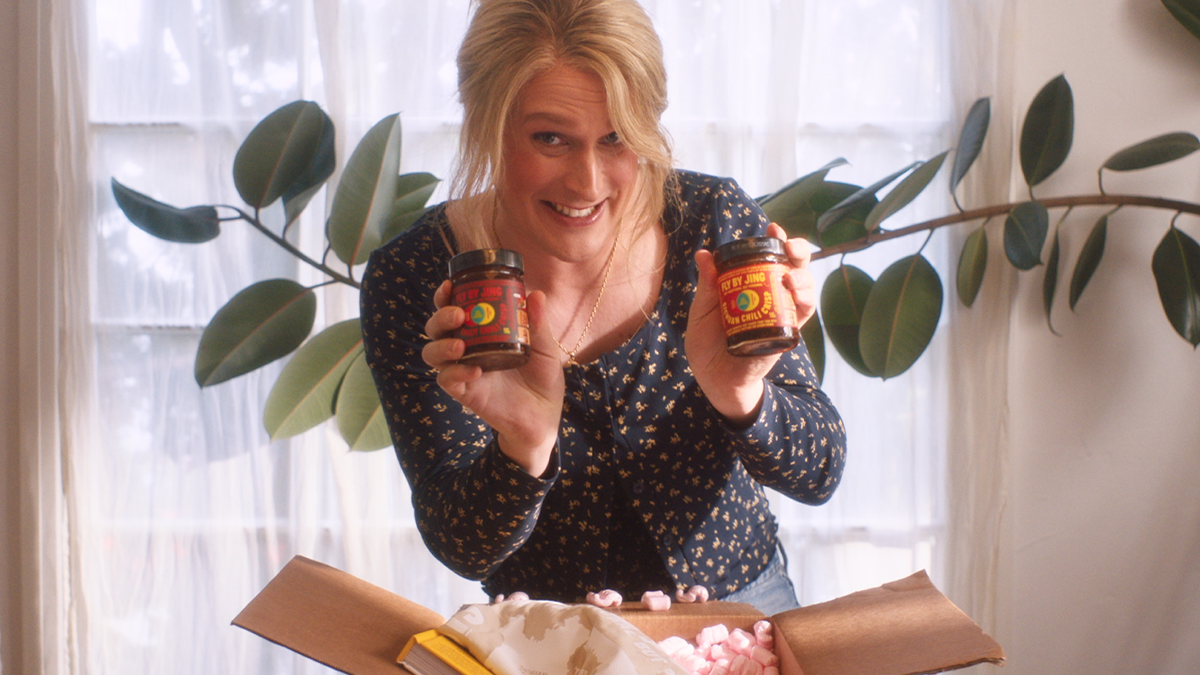
Early stars as Maddie Ralph, an aspiring food personality whose sudden ascent from dishwasher to online culinary star transforms a private passion into something meant to be consumed by an audience. Her newfound visibility also coincides with the return of an eating disorder she has struggled with since childhood, turning the film’s seemingly ridiculous premise into something increasingly painful. What makes Maddie’s Secret so remarkable is Early’s refusal to resolve that contradiction by simply becoming less funny. The comedy remains enormous even as the stakes become frighteningly real.
It is a perfect subject for Early because his comedy has always understood performance as both armor and confession. Here, he finds a format expansive enough to contain the anxieties that have defined so much of his generation: the commodification of personality, wellness culture, therapy-speak, social media, body politics and the exhausting expectation that every private experience must eventually become legible to an audience. Maddie exists at the intersection of all of them. Her identity is increasingly constructed through screens, cameras and the perceptions of people who believe they know her because they have consumed her image.
The film’s cinematography makes that sensation unavoidable. Early and cinematographer Max Lanker embrace the lush artificiality of melodrama rather than using the flatter visual language typically associated with contemporary satire. The result is a movie that is constantly conscious of the act of looking. Maddie is framed, photographed, recorded and watched; her body becomes both character and image. There is an almost meta quality to the camera’s obsession with her, particularly as her professional success increasingly depends upon her willingness to turn herself into content.
That makes the film’s treatment of body image especially sharp. Maddie’s Secret arrives at a moment when the language surrounding bodies has become more contradictory than ever. Body positivity exists alongside an enormous market built around changing those bodies; public conversations about acceptance coexist with renewed cultural fixations on thinness and weight-loss drugs. Social media encourages people to celebrate authenticity while simultaneously providing the surveillance apparatus through which bodies can be scrutinized endlessly. Early recognizes the absurdity of these contradictions without treating the eating disorder at the film’s center as an absurdity itself.
It is a crucial distinction. The world surrounding Maddie is funny; her suffering is not.
That separation allows Early to indulge in outrageous theatricality without sacrificing tenderness. His performance is enormous but never hollow. Maddie’s mannerisms, anxieties and relentless optimism might initially register as extensions of Early’s familiar comedic sensibility, yet the longer we spend with her, the harder it becomes to maintain any ironic distance. Early commits so completely that the question of whether we are watching parody eventually becomes irrelevant. Maddie simply becomes Maddie.
Kate Berlant’s Deena is essential to that transformation. Early and Berlant have spent years developing a comedic language together, and their comfort is immediately apparent. Their scenes have such an effortless rhythm that the relationship between Maddie and Deena occasionally feels like an even stronger emotional anchor than the film’s central dilemma. They understand how to make something feel simultaneously rehearsed and spontaneous, affectionate and antagonistic, absurd and completely recognizable. Berlant can react to Early with the smallest shift in expression and suddenly recalibrate an entire scene.
There is also something moving about watching two performers so closely associated with a particular generation of alternative comedy bring that sensibility into a film this formally ambitious. Maddie’s Secret does not feel like Early translating his comedy into conventional cinema. It feels like him discovering the cinematic language that was always waiting for it.
That may be the film’s greatest surprise. What could have remained an elaborate extension of a sketch becomes a genuinely beautiful object. Early understands that camp is not synonymous with carelessness. Every heightened gesture, melodramatic turn and visual flourish is part of an extraordinarily controlled construction. The artificiality becomes its own kind of honesty.
And perhaps that is why Maddie’s Secret has emerged as one of 2026’s most unexpected indie triumphs. In an era obsessed with authenticity, Early makes a film in which virtually everything feels artificial, performance, celebrity, social media, melodrama, even the identities we present to one another, only to discover something remarkably sincere underneath it all.
Maddie’s Secret is hilarious because Early understands how ridiculous contemporary life has become, but it is moving because he refuses to believe that ridiculousness makes our suffering any less real. Beneath the wigs, food videos, theatrical breakdowns and carefully constructed images is a woman desperately attempting to reconcile the body she inhabits with the version of herself the world wants to consume.
Early turns that contradiction into spectacle. Then, somehow, he makes the spectacle feel intimate.